



Blog: From antiviral activity to human outcomes
From antiviral activity to human outcomes: a translational modelling workflow for emerging infectious disease therapeutics
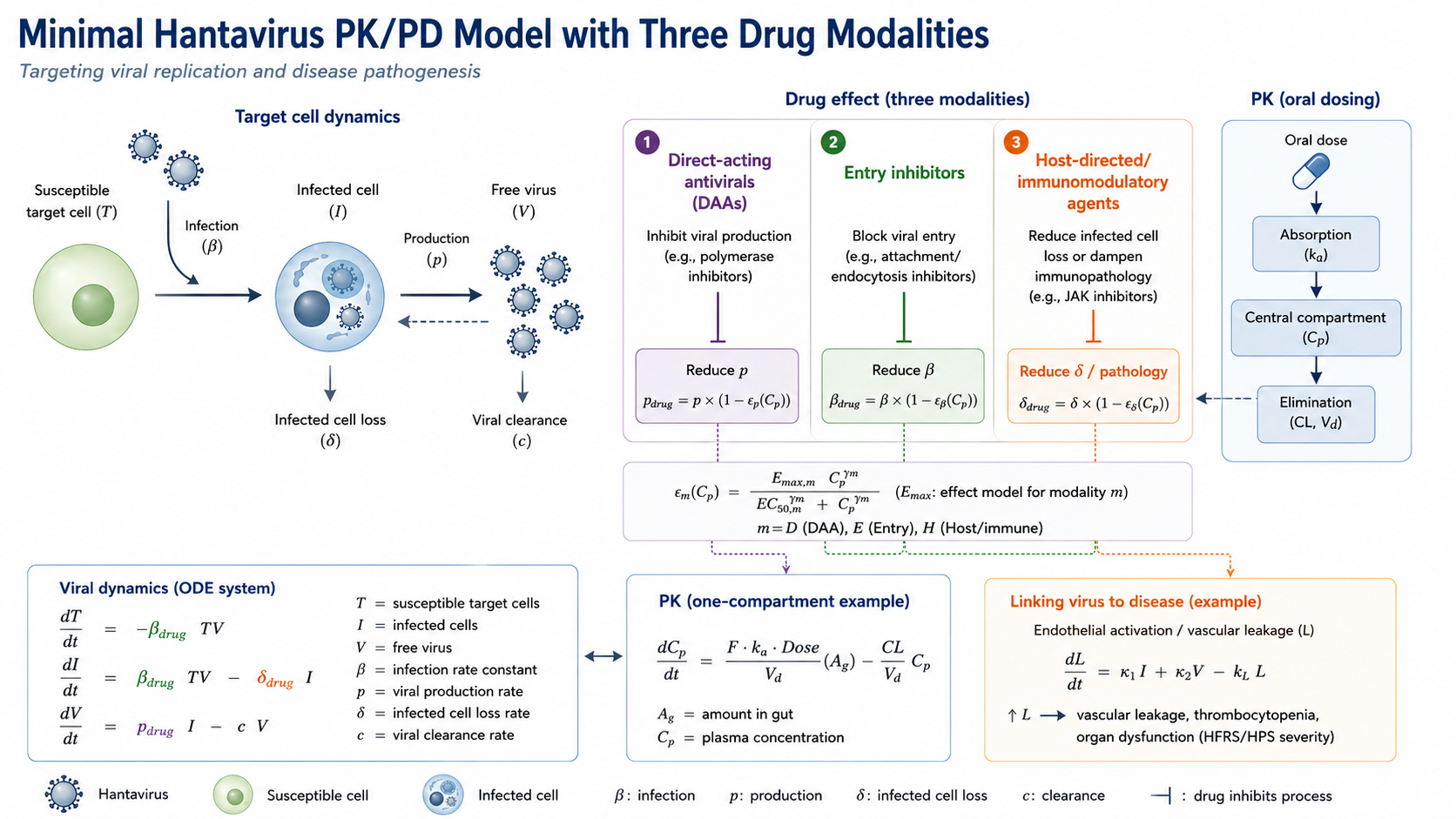
Emerging infectious diseases continue to highlight an important challenge in therapeutic preparedness: the ability to move rapidly from laboratory signal to clinically meaningful decision-making and treatment, or containment options. While hantavirus currently represents a comparatively low global public-health threat relative to pathogens such as influenza, SARS-CoV-2, Ebola or dengue, recent attention around hantavirus outbreaks serves as a critical reminder of the broader gaps that still exist in outbreak-response infrastructure and therapeutic readiness.
Global health organisations, including the World Health Organization (WHO) continue to emphasise the importance of preparedness frameworks capable of supporting rapid responses to emerging pathogens, particularly those with pandemic potential or severe clinical outcomes. Hantaviruses are relevant in this context not because they currently represent a high-likelihood global emergency, but because they illustrate a recurring problem seen across emerging infectious disease programmes: the gap between early experimental activity and translational confidence.
During outbreak responses, high-throughput screening efforts can rapidly generate large numbers of apparent antiviral “hits”. In the COVID pandemic, significant efforts went into evaluating repurposing opportunities for treatment of COVID. Compounds may demonstrate measurable activity in cellular assays, often within days or weeks of screening initiation. However, in vitro activity alone is rarely sufficient to determine whether a therapeutic candidate has meaningful clinical potential.
A compound that appears promising in an assay can still fail for multiple reasons. The concentration required for antiviral suppression may not be safely achievable in humans. Drug exposure may not remain above the required potency threshold for long enough to meaningfully affect infection kinetics. A mechanism that reduces viral replication in a simplified experimental system may have limited impact once host biology, tissue distribution, immune dynamics and between-subject variability are considered. These translational questions are often where otherwise attractive repurposing candidates fail.
This is where translational modelling can play an important role.
By integrating antiviral potency data with known human pharmacokinetics, mechanistic viral dynamics and population variability, modelling frameworks can help determine whether a candidate has a plausible path toward clinical relevance before major development resources are committed. Rather than replacing experimental work, this approach helps structure the decision-making process around it. At Physiomics, we’ve developed a translational modelling framework to demonstrate how an integrated approach offers an efficient and human-relevant assessment of anti-viral candidates. You can see it here.
The workflow illustrated in our hantavirus example demonstrates how these layers of evidence can be connected into a coherent translational framework. High-throughput screening data identify initial signal. Concentration-response modelling estimates potency parameters such as EC50 and EC90. Clinical pharmacokinetic models then assess whether those exposure targets are realistically achievable at safe dosing regimens. Mechanistic PK/PD models explore how different antiviral modalities may alter viral kinetics, while virtual population simulations quantify how variability may influence predicted outcomes across individuals.
Importantly, the framework itself is pathogen agnostic. Although hantavirus provides a timely and scientifically interesting example, the same principles are applicable across a broad range of emerging infectious disease settings, including respiratory viruses, arboviruses and future outbreak-response scenarios where rapid therapeutic prioritisation may be required.
As Dr Shaun Pennington, who helped lead SARS-CoV-2 therapeutic screening activities at the Liverpool School of Tropical Medicine during the COVID-19 pandemic, commented:
“One of the key lessons from COVID-19 was that speed matters, but so does biological and pharmacological context. Screening compounds for antiviral activity is only part of the picture. The most useful approaches are those that combine preclinical efficacy data with what is already known about human pharmacokinetics, exposure, safety and dosing feasibility. For emerging threats such as hantaviruses, this type of integrated analysis could help identify repurposed candidates that are not only active in experimental systems, but also have a plausible route towards clinical impact.”
In outbreak settings, speed matters, but fast decisions still require structure. Translational modelling provides a framework for asking the next scientific question at each stage of evidence generation — not simply whether a compound is active, but whether its activity is likely to translate into meaningful human outcomes.
Do you have antiviral screening, PK, or repurposing data? Speak to us about a rapid translational assessment.